
Model the relationships that turn isolated weaknesses into viable compromise paths.
Enterprise Autonomous Red Team Platform
Simulate real adversaries.
Reveal the attack path.
MAUNG is an enterprise autonomous red team platform that maps, validates, and prioritizes compromise paths across identity, network, cloud, and critical business systems—turning offensive security into measurable resilience and executive-grade risk clarity.
ContinuousAttack-path validation
GovernedControl, approvals, and safety guardrails
Evidence-gradeTechnical evidence and executive reporting

Autonomous reconnaissance
Attack-path validation
Multi-agent orchestration
Executive risk intelligence
Safely verify exposure through controlled actions rather than theoretical severity alone.
Prioritize remediation by real business reach, critical assets, and adversary feasibility.
Re-test continuously and demonstrate whether security controls stop realistic attack chains.
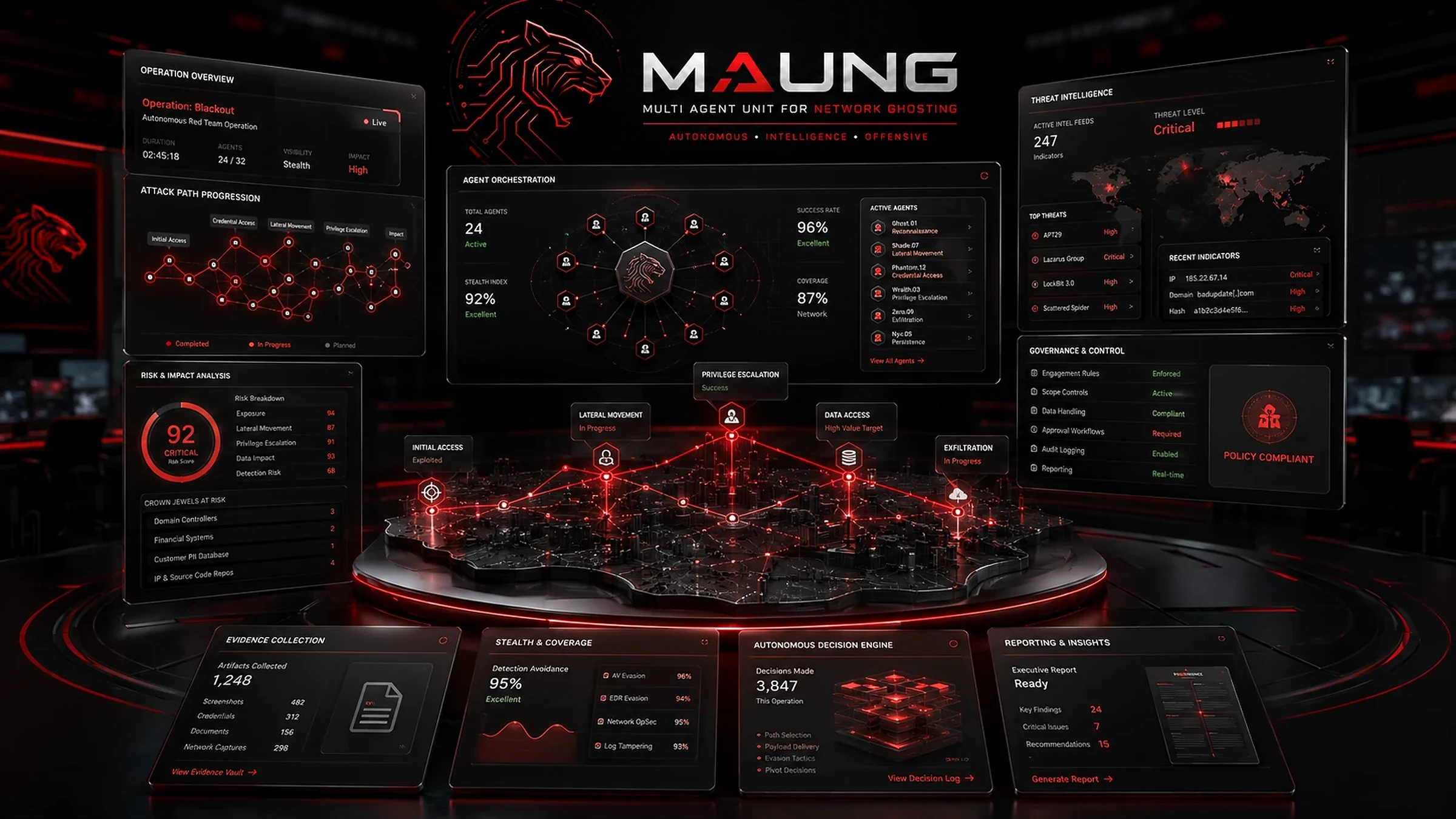
MAUNG Command Center
A premium control plane for enterprise offensive operations.
Replace fragmented point-in-time engagements with a unified operating system for continuous adversary simulation, evidence management, remediation validation, and executive risk communication.
01
Coordinate specialist agents across complex enterprise environments.
- Parallel reconnaissance and attack-path analysis
- Agent specialization by identity, network, cloud, application, and data
- Mission-level objectives, constraints, and adaptive task orchestration
02
Convert potential exposure into safely validated enterprise risk.
- Controlled proof of exploitability within predefined guardrails
- Attack-chain reconstruction and critical-asset reachability
- Re-test workflows to verify that remediation is effective
03
Keep every autonomous action visible, approved, and auditable.
- Rules of engagement, protected assets, and prohibited-action policies
- Role separation for operators, approvers, reviewers, and auditors
- Complete action logs, decision records, evidence lineage, and kill switches
04
Translate offensive findings into decisions executives can act on.
- Board-ready exposure narratives and remediation priorities
- Technical evidence packages for engineering and control owners
- Trend reporting for attack-path closure and control-effectiveness assurance
Core Capabilities
Purpose-built for enterprise red team operations.
Deep offensive capability, coordinated by autonomous intelligence and bounded by enterprise governance.
Autonomous Reconnaissance
Continuously map attack surfaces, services, identities, assets, technologies, and trust relationships across hybrid environments.
- External and internal discovery
- Identity relationship mapping
- Cloud and SaaS exposure analysis
Multi-Agent Orchestration
Deploy coordinated specialist agents that operate in parallel while sharing mission context, evidence, and constraints.
- Specialized offensive roles
- Adaptive mission planning
- Human approval checkpoints
Attack-Path Validation
Identify and safely prove the sequence of weaknesses needed to reach privileged identities, critical systems, and sensitive data.
- Privilege escalation paths
- Lateral movement analysis
- Critical-asset reachability
Threat-Informed Operations
Align missions with relevant adversary techniques, organization-specific threat scenarios, and current intelligence.
- MITRE ATT&CK alignment
- Threat scenario emulation
- Technique-level coverage
Evidence & Replay
Capture reproducible technical evidence, action timelines, artifacts, and remediation context throughout every mission.
- Evidence chain and replay
- Finding deduplication
- Engineering-ready guidance
Executive Risk Intelligence
Connect technical compromise paths to business services, critical assets, control gaps, and investment priorities.
- Business-impact translation
- Exposure trend reporting
- Board and risk committee outputs
Enterprise Operating Model
Human-led strategy.
Machine-speed execution.
MAUNG augments skilled red team operators. Humans define objectives, context, ethics, and approvals. Autonomous agents perform coordinated discovery, validation, evidence collection, and continuous re-testing.
Discuss your operating model →Define the mission
Targets, business context, scope, protected assets, safety controls, and success criteria.
Approve autonomous boundaries
Rules of engagement, action policies, rate limits, approval gates, and kill-switch authority.
Orchestrate offensive agents
Parallel specialist agents map, reason, validate, pivot, and preserve mission evidence.
Prioritize enterprise exposure
Findings are ranked by exploitability, attack-chain position, business reach, and criticality.
Remediate and continuously assure
Owners receive focused guidance; MAUNG re-tests closure and reports residual exposure.
Enterprise-Grade by Design
Maximum offensive insight. Controlled enterprise impact.
A premium platform must be trusted by security operations, technology owners, risk functions, internal audit, and executive leadership—not only by red team operators.
 MAUNG
Governance Core
Rules of engagement
Approval workflows
Safety guardrails
Audit & evidence
Explicit assets, networks, identities, applications, techniques, and operating windows.
Prevent autonomous actions against designated systems, data, and fragile dependencies.
Require human authorization before sensitive actions, escalation, persistence, or data access.
Distinct roles for mission designers, operators, approvers, control owners, and auditors.
Preserve actions, inputs, decisions, evidence, model context, and operator interventions.
Immediately pause agents, missions, or the full control plane when conditions change.
Configurable retention, encryption, access control, export, and legal-hold alignment.
Portfolio-level dashboards for risk reduction, coverage, remediation, and residual exposure.
Review platform security, data handling, deployment boundaries, and control principles.
Open the Trust Center Deployment Architecture
Designed around enterprise risk appetite.
Choose the operating boundary that matches regulatory, data-residency, and infrastructure requirements.
Enterprise SaaS
Isolated enterprise workspace with managed platform operations and controlled connectivity.
- Fastest time to value
- Enterprise SSO and RBAC
- Regional hosting options
- Managed upgrades
Recommended for regulated enterprise
02Dedicated Control Plane
Dedicated tenant architecture with private connectivity and customer-defined data boundaries.
- Private network connectivity
- Dedicated encryption boundary
- Customer-controlled retention
- Enhanced governance options
Private / On-Premises
Operate MAUNG inside a customer-controlled environment for highly restricted missions and data.
- Isolated deployment
- Customer-managed infrastructure
- Offline or restricted operation
- Custom assurance model
Enterprise Ecosystem
Operationalize findings in the tools your teams already use.
MAUNG integrates through governed APIs, event streams, and export workflows to reduce friction between offensive validation and remediation.
SIEM & SOARDetection validation, event enrichment, response orchestration
EDR & XDRControl validation, telemetry correlation, technique coverage
IAM & PAMIdentity paths, privileged exposure, access-control assurance
Vulnerability & ASMExploitability validation, prioritization, remediation context
ITSM & CMDBOwnership mapping, workflow creation, closure verification
Threat IntelligenceThreat-informed missions, indicators, adversary technique context
Executive Value
Turn offensive security into a measurable enterprise capability.
The platform creates a repeatable operating model for exposing material attack paths, assigning accountability, validating remediation, and communicating residual cyber risk.
Security leadershipPortfolio visibility and investment prioritization
Red teamScaled execution and persistent mission context
EngineeringReproducible evidence and focused remediation
Risk & auditTraceable assurance and control-effectiveness evidence
Executive committeeBusiness exposure and residual-risk narrative
Enterprise Questions
Built for serious operational scrutiny.
Key considerations for security, technology, risk, procurement, and architecture stakeholders.
No. MAUNG augments experienced operators by scaling repeatable discovery, analysis, controlled validation, evidence capture, and re-testing. Humans retain mission intent, approval authority, ethical judgment, and final accountability.
Actions are bounded through mission scope, protected assets, prohibited techniques, rate limits, operating windows, approval gates, action policies, and emergency stop controls.
The target architecture supports enterprise SaaS, dedicated control-plane, hybrid connectivity, and private deployment patterns. Final suitability depends on the customer’s regulatory, residency, and infrastructure requirements.
Mission actions can produce timelines, affected assets, attack-chain context, screenshots, technical artifacts, decision records, operator interventions, and remediation guidance with configurable retention.
MAUNG is positioned as an enterprise platform. Commercial structure is tailored to deployment model, protected environment scale, mission scope, agent capacity, integrations, assurance requirements, and support model.
Private Enterprise Demonstration
See what others cannot.
Secure what matters.
Request a confidential demonstration, target architecture discussion, or enterprise evaluation workshop.
Confidential discovery
Enterprise architecture review
Deployment and commercial alignment